This week Awayday radio caught up with Gilly Black from Bulgarian side FC Lokomotiv Gorna Oryahovitsa’s Jolly Roger firm.
A group that models itself on English hooligan scene, emulating their dress sense and style of support, as well as incorporating a Union flag into its logo.

Proud Sponsors of The Terrace Casuals Interviews. (click pic for link)
Hiya Gilly, Right firstly how did you get into football and when?
Hi. Before to answer how did I get into football and when I would like to introduce to you about my
beloved club and Jolly Roger Firm.
LOKOMOTIV was the name of our beloved team and the representative football club for Gorna
Oryahovitsa, Bulgaria. The club was founded in 1932 and is considered as SC Levski’s successor.
After 1945 it was joined by other teams from Gorna Oryahovitsa. In the pre-war years, the team played its official games at the “Yunak” ground and later on at the Kaltinets ground, which was one of the first stadiums, built in the country. In 1956 FC Lokomotiv (GО) moved to the newly opened all-seater town stadium named after the club with a capacity of 12.000. The club is not very successful and just like the town it represents it is a rather small Bulgarian team. The most successful years for the club were when it played for the second time in League One. This happened after the 1986/87 season when the “railwayman” from Gorna Oryahovitsa finished second and won promotion to the first division.
There Lokomotiv (GО) played for eight consecutive years, its best seasons being 1989/90, 1990/91 and 1993/94 when they finished eighth. Our older supporters remember that several Bulgarian major clubs were defeated in Gorna Oryahovitsa in those years.
The eight years in question coincided with the fall of the communist regime and the period of
transition that followed and Lokomotiv’s last season in League One, 1993/94, coincided with the
USA World Cup, when the Bulgarian national team made its greatest achievement in history. One of the leading players in the Bulgarian golden generation at the World Cup was Ivaylo Yordanov, who in 1990/91 was Bulgarian top scorer playing for Lokomotiv. Afterwards, he was transferred
to Sporting Lisbon where he made a fantastic career both in Portugal and Europe. In 1992 the team won the former Intertoto Cup. After playing Lokomotiv Sofia, Rapid Bucharest and Arges
Pitesti, Lokomotiv (GО) finished first in their group. Being the group winner, in the next round, our team played the strong Russian side Rotor Volgograd. The game in Gorna Oryahovitsa
finished in a 1-1 draw, and in Russia, Lokomotiv (GО) was eliminated after a 2-0 defeat. In 1995 Rotor Volgograd knocked out Manchester United in the very first round of the UEFA Cup.
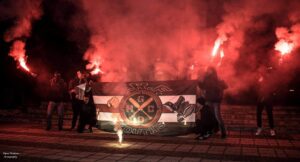
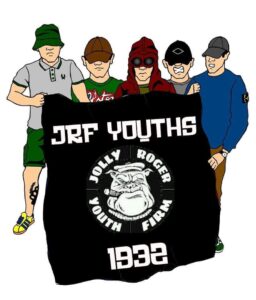
We have a firm, it was established in 1995 and it is called J.R.F. (Jolly Roger Firm), or the “Jolly Roger” company. I had the great honour of being one of the founders of the firm, which was, as
one might say, originally Pro-British orientated as it was founded by a dozen lads who besides supporting Lokomotiv (GO) were also fans of British football both at club and national team levels.
The firm was called the Jolly Roger after a song and album named “Under Jolly Roger” by the German heavy metal band Running Wild. Its logo was the skull and crossbones and the classic of it was the Union Jack flag with the Running Wild band logo on.
British football and the hooligan culture and not the ultras culture so typical of the Balkans! You understand that this automatically renders useless some of your next questions like the use of pyro,
but never mind, let’s go on. On our best days, we used to gather about 60 people in just a few minutes by only making a single phone call. I’m speaking of a core of lads who shared
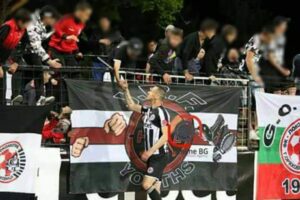
identical views and, taking into account the size of our town, I think that was quite a decent number. I could agree to some extent that the reason for founding the firm was Lokomotiv (GO) relegation from Division One down to the lower echelons, but basically, the organization is focused on real friendship not only on the terraces but in life in general, which in itself makes the firm pretty unique and distinctive. What we used to prepare as choreography before games were huge flags with our own ideas and symbols on.
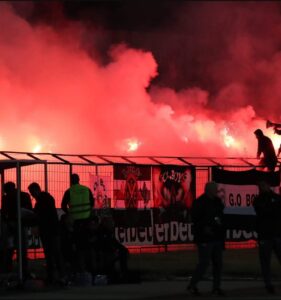
I first went to a football game with my Dad during the 1986/87 season. It was our team’s last game in the second division. I was a 10-year-old kid then. It was 7th June 1987, a hot and sunny day, and Lokomotiv (GO) played its last decisive game for promotion in Division One against a team called Svetkavitsa (Targovishte), which had already been relegated. However, such teams would always try to make things go wrong and on that day we just hoped they wouldn’t. The atmosphere was unbelievable; chants were being heard everywhere, even beyond the ground. A real town festival. Fans wouldn’t stop singing and cheering their team. In front of a crowd of 6000 having the presentiment that their 24-year-old dream would finally come true, Lokomotiv deservedly won 3-0 and so we were promoted. In addition to my brilliant impressions from the team’s performance and the astounding win, my eyes were riveted to the opposite stand where our fanatics stood. A huge mob of black-and-white fans famous for being one of the most passionate and dangerous supporters in the country. Time and again, the police would have problems dealing with them. I enjoyed their unruly temper and hooligan behaviour and I dreamt about the day I would be one of them.
What was your first memory of trouble at a football match?
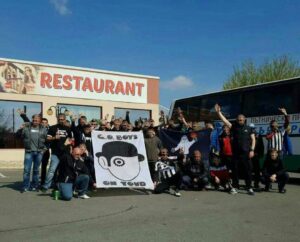
It was the autumn of 1987 when I attended my first memorable away game in the town of Pleven accompanied by my father. Lokomotiv (GO) played the local Spartak in a Division One game. Back in those days, trips were usually made by rail not only because of the cheap railway fares but also because of the excitement felt when a massive support of fans arrived in a strange town. At the railway station in Gorna Oryahovitsa, there were about 2000 black-and-white fans armed with carboys and gallons of home-made wine and rakia (A collective term for fruit or grape brandy popular not only in Bulgaria but all over the Balkans with an alcohol content of normally 40% ABV). An army waving black and white scarves and flags.
An entire train had been specially arranged for the trip to Pleven. Most supporters had been drinking since early morning well lubricating their throats for singing at the game. Naturally, there was chaos and disorder even at the station and the people who took an active part were adults, not children. Those were mainly working-class blokes from the local factories. They had decided to pay their dues to the team by supporting it in its first away game after a 24-year-long exile in the lower divisions. Of course, “The Steel Hearts” team was also there, my father in their ranks holding my hand. I was a 10-year old boy among a bunch of tough men. Boarding the train was accompanied by chants and cheers, the windows were covered with flags and all across the carriages, there was alcohol. The cops tried to force down some lads due to their ongoing alcohol abuse but they were helpless confronting that huge army.
A powerful roar echoed all over the place as the train started to pull out of the station, amplified by the sounds of fists and feet thumping like hammers on the carriage metal. The mighty rumble echoed on after the train left the station. Finally, we had hit the road. Instantly some compartment parts (racks, seats, tables) were torn off and thrown out of the windows. The streams of wine went on flowing. The Gamza (A dark-skinned variety of grape used for making red wine) was raging inside the men’s stomachs and heads. Upon our arrival at the railway station in Pleven, the youngsters started blowing up minium-bronze bombs and igniting smoke bombs, while the older lads, just to keep step with them, began to hurl empty bottles. What followed was total anarchy. Bystanders waiting to change trains started screaming in terror and running away. Never before had they witnessed such mayhem. It was as if a herd of weird wild animals had been let loose. A police escort assisted our march to the ground. During the game, the atmosphere on the terraces was tense and uptight. Insulting chants could be heard directed at the locals and their team. There was a pending danger from even more severe disorder. Spartak was ahead 2-1. In the dying minutes, a large group of our fans invaded the pitch. The referee had to suspend the game for several minutes. The huge unruly crowd knocked down a concrete fence. Put under the pressure of hundreds of arms and legs it just collapsed as if made of cardboard. The coppers nearby started using their batons, pulling and dragging away some fans like they were animals, while other supporters were being handcuffed.
The rest of the crowd was pushing its way to the pitch. After the final whistle, a street war began. On route to the train station, the rowdy and arrogant black-and-white army went on a rampage. Stones, bottles and all kind of debris were hurled at shop windows and parked vehicles. A car driven by a woman was attacked. The fans kicked and pushed the vehicle, denting one of its doors. Some natives intervened and it grew into a mass brawl. It was kicks and punches everywhere. The OB could not handle the tidal waves of fans hungry for violence. Some ran into the narrow streets around the stadium chasing their opponents, overturning dust bins, etc. A lot of locals were badly beaten and most of them were lying on the streets noses and heads bleeding. It was a blood bath and it happened in just a few minutes. Bloody scared, I was holding tight my Dad’s hand as he was hurrying to the station. Despite my fright, I felt the blood boiling in my veins and all of a sudden I felt an urge to join the battle. I wanted to fight beside the others, but I was still a kid. Trying to protect me, my father punched several men and I watched his giant arms crush their jaws. I distinctly heard the pounding sounds and saw the blood all around us.
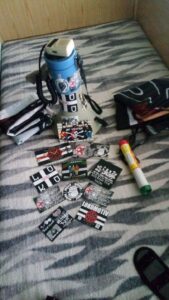
Matchday essentials
The cops also saw what was going on and responded by hitting my father with their batons several times. I believed the entire town police force was mobilized. In the years to follow, I never happened to see again such a massive police escort to guide us back to stations. That game would be long remembered and even to this very day, people talk with fear about what happened then. I am pretty certain that day is registered as one of the worst days of violence in the history of football hooliganism in Bulgaria.
On our way back to Gorna Oryahovitsa I asked Dad why our fans were doing that and he replied: “They do it out of love for their football club. One day you’ll understand!” Deep inside I
had already felt it and had understood. The seed of football hooliganism was sown and I was dreaming of becoming one of the thousands of hooligans I saw then. It was on that very day that I
realized football was my love and obsession.
When did you become a football casual?
I would say around 14/15 something like that and in the mid-1990s we officially founded the Jolly Roger Firm and it started growing at a tremendous speed. For some, it was only fashion. Lads would gravitate around the main core and in a while, they would just be gone as unnoticed as they had appeared. However, for others, it became a real drug and they would become more and more addicted and in need of it.
Who are your main rivals?
Our arch-enemies or main rivals are the supporters of Etar, the club from Veliko Tarnovo and their bastards calling themselves the “Boyars” or the “violets”. We loathe them! We have always been at war with them. We have never liked them and we shall never have any respect for them.
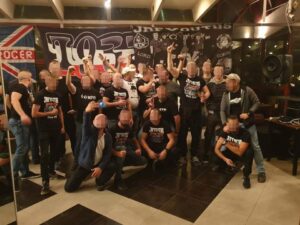
I will try and summarize our hatred for those tossers. The rivalry between Lokomotiv GO and Etar dates back to the early 20th century. Our derbies have always been rather tough games full of riots and fights. Both towns are divided by only 7 miles across the Arbanasi Ridge and they were some of the founders of the football game in Northern Bulgaria along with two other famous local rivals, i.e. Spartak from the town of Pleven and Yantra from the town of Gabrovo. Our hatred for the Boyars has always been strong and we have never felt any sympathy for them. We hate them and we hate their team. What is the reason for that? Political and social life has always been a top priority for the town of Tarnovo. We are working-class people living in an industrial town and they are former capital citizens relying on material goods mainly coming from us. They have always believed they belonged to the upper class in society and considered us as “some railwaymen” (due to the great percentage of people employed by the railways). Our football backgrounds have always been different – they were champions of Bulgaria, most of the seasons they played in the top flight and they would always find ways to save their asses even when they were on the verge of relegation down to the Amateur League. For them, we were just a small-town club as we had only several seasons in the top league and most of the time we would play in the lower echelons. Besides, we could not boast of huge financial resources and we had never been champions. What we had were courageous players and extremely loyal supporters. Whenever a star player would appear from our academy, they would find a way to sign him and it would always be a good bargain for them. Dislikes were manifested during the games we would play against each other as it would be most intense and tough games featuring sent-off players almost every time. It is around those derbies that the seeds of hatred were sown. We have always found a way to meet them face to face on the terraces and in the streets, to challenge them and get what we all wanted and that was to kick a Boyar’s ass or two, to smash their faces in, to shed their blood on the pavement, to stamp them out like the animals they were. There were occasions on which we would beat the shit out of them in their very den, but they just wouldn’t admit defeat. Now, as we are writing this book, they are in the second division and their fans are gone. They are gone because they betrayed their club and they have never really loved football. They will always be violet cunts, while our club has always enjoyed real and constant support, even when it played in the lower divisions in the last 15 years. The difference between us and them is that we are proper fans and we will always be, no matter which division our team plays in, while they will always be pathetic wankers and glory hunters.
What was your biggest battle with them?
There were many, many battles with them… It was the spring of 1995. We were walking on the razor’s edge in the lower part of the table winning this week and losing the next one. We had some impressive wins against the leaders, but
we lost 1-2 at home to our bitter rivals Etar. After what we had done in their town, we expected strong support of theirs to arrive at our ground. Some of our lads got in touch with their
ringleaders and we did expect a huge turnout. This time we knew they had organized a coach trip, which in a way facilitated our job as we didn’t have to wait for them at the train station as we
had done in the past. We also anticipated an enormous crowd of home supporters not only because we were hosting our archenemy, but also because we had beaten the leaders in the table Levski
two weeks before. All-day long we prepared for the event, discussed where and how it would be best to have a go at them before and after the match, though we knew it would be extremely hard
to break through the police escort and get at their coaches before the kick-off time. Furthermore, the Boyars were expected to arrive right before the game to avoid any trouble and
confrontation. This time the police had been well prepared given what happened in Tarnovo in the autumn. However, hardly anyone had the illusion that the day would end with no violence
and riots whatsoever. We mobbed-up downtown several hours before the kick-off time. Naturally, we needed to oil our throats with alcohol. There were also those of us who could barely stand on their feet as they were properly pissed by then. Anyway, our mob was just huge, about 150 lads. It was all white and blue flags and scarves. The entire centre of the town was flooded with fans and their songs echoed all around. Some were singing, others were blowing up bombs or lighting up smoke
canisters, while still others were lying on the pavements weary of the amounts of booze they had devoured. A huge sea of fans. This was probably one of our best turnouts. We were watched by the
Old Bill but there were no grounds for serious trouble. We set off for the stadium. The streets were echoing with our songs and chants. We saw some elderly people and mothers with their children look for shelter in their homes as no one could be sure what could happen at any time. Everybody
was well aware of what the unpredictable Gorna Oryahovitsa mob was capable of doing and
everybody was familiar with their history of numerous outrages. On approaching the ground we
could hear the crowd shouting and we also recognized the much-loathed songs sung by the Boyars.
They had already arrived and had stood in the away end. Our info was that there were two coach loads of theirs carrying some 80 more hardcore fans. The ground was full, even more than usual.
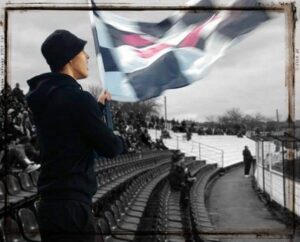
There were probably about 15 000 people who had come to watch the big regional derby. While getting escorted to the section we always used to gather we challenged the violets with insulting
gestures and stones thrown in their direction. The first whistle almost made the ground erupt. Everybody jumped to their feet and we started singing out loud, throwing bombs and lighting
smoke bombs and flares. Flags were flying high across the entire ground. The Boyars hit back by lighting up their sector with pyro. It looked like it was gonna be a memorable day and unbelievable support from both sides. During the game, we made plans on how to get at them after the final whistle. No one thought it would be easy due to the massive police presence. Nothing
remarkable happened till the end of the game, apart from the ejection of some of our lads due to being drunk and disorderly. Well, it was inevitable as some went on drinking even during the game. After Etar scored their second goal in the 90th minute, led by our anger and disappointment, we stormed the fence and it simply collapsed under our weight. The metal railings looked like just a useless pile of iron. We tried to jump over the debris and some of us even went closer to the pitch. The cops were doing their best to restore the order and they would tug away our boys and hit them on their heads with their batons. The Boyars were madly celebrating their victory, but at the same time, they were busy collecting their flags to sneak out of the stadium. We waited for some time until the ground was empty and their fans were gone along with the OB. We regrouped into smaller mobs to move faster, catch up with and have a go at them.
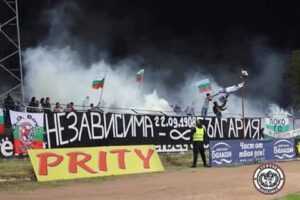
They were heading for the bus station where their coaches were. We followed them at some distance. At
one of the bus stops along the way we saw a group of Boyars surrounded by cops. Our mobs reunited and a mighty black-and-white wave of tough lads went towards them. However, we
couldn’t get at them immediately due to the heavy police presence. The distance between the two mobs was no more than 100 yards. A large part of our mob split off and headed for the main road
leading to Tarnovo in the vicinity of the local hospital. Our idea was to attack their coaches with
bottles and stones to challenge them. The area was suitable for battles as there were some
narrow streets and places where you could easily get lost. If our plan worked, the rest of us had to back up our first line. A wall of police shields was protecting the violets. We were challenging them and the cops were keeping us apart with great difficulties. Stones and debris were flying at the Boyars from our rear lines. The entire bus station was taken over by our lads. At one point their coaches arrived and they started getting on, hurling insults and obscene gestures at us. We
were wondering how to get through the police barrier and get at them since we couldn’t let them leave just like that, with no consequences. One by one their coaches were off to Tarnovo escorted
by two patrol cars. We ran after them sticking to the plan to back up our mates who were already waiting at the fork before the main road to Tarnovo. While we were running to our destination we heard sirens wail and saw the people from the neighbourhood hide in their homes, startled by the
noise made by the hundred or so irate fans running. One of our lads waiting for us at the road split told us that they had managed to smash the windows of the two coaches and the Boyars had
got off and had a go at our mob. We quickened our pace and when we got nearer we saw the
violets running in all directions. We started chasing them, scattering in the small streets, and it kicked off everywhere.
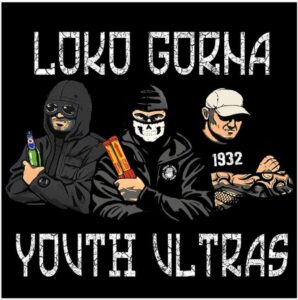
I was with some ten other lads and we had a go at 4 or 5 of their mob. We exchanged punches and I got blood all over my clothes as my head was busted open (probably with brass knuckles). The cops appeared and went at us in a baton charge so we dispersed into the narrow side streets. While running, we saw another mob of ours fighting some Boyars. We ran
over to help them and readily joined the fight. You could hear the sounds of punches hitting jaws and heads. Couples were fighting all around, some were already down wrestling on the ground
and others were using Kung Fu style kicks. One or two of them were lying on the pavement and
the others fled in the direction of their coaches. We saw more cops coming our way and a police patrol car was about to cut off our way. We scattered intending to hide around the nearby residential buildings and evade
the coppers. One could still hear screams and shouts and siren wails. In a while, there was complete silence. Dusk had started to descend upon the town and I
headed for our pub, meeting some of my mates on the way there. I was told that there were lads nicked both from our mob and the Boyars. The rest of the away fans had boarded their coaches
and were off to Tarnovo heavily escorted by the police. In the pub, everyone was telling about our great experience, i.e. how we defeated them, how they ran away in fright and how several of them
had their asses kicked hard. It was clear that we defeated them for a second time, now at our territory, and although we were slightly chaotic (we didn’t get the chance to act in a more
organized manner), we had another victory over our arch enemy.
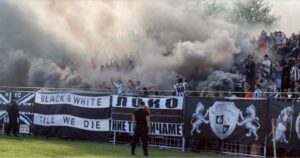
Who else did you have a big battle with?
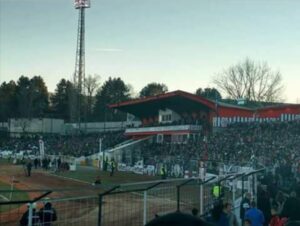
Yes, it was on 18th September 2004, when Lokomotiv (GO) and Botev played against each other in the second division. There were rumours that our mob would feature some Lokomotiv Plovdiv hooligans as we were on friendly terms with them. Probably that was the reason for the alleged threats of violence coming from the Bultras mainly on Internet forums that we cannot say were genuine, but videos of what happened after the game could be found on Youtube and I think they tell the whole story. Whatever the reason, we expected a huge turnout from them and JRF was also at its height and up for it. In those times Botev fans were also on the rise having one of the leading hooligan firms in Bulgaria that would go on a rampage unpunished in any town and stadium they played across the country turning them into real battlefields. That was part of the war they had declared against their club owner then. The club’s financial instability and the club owner’s attempt to sell the club resulted in acts of vandalism by their hooligans as they were trying to discredit and put additional pressure on him taking into account the considerable fines the club had to pay for those acts of violence and vandalism. There were also death threats against their club owner followed even by attempts made upon his life. Several games before, the owners of the club that hosted their away fixture threatened to electrify the away end fencing on their ground to prevent the Bultras from invading the pitch again! After that incident, Botev fans must have taken themselves too seriously and were probably looking forward to doing the same things in our town. Whatever had happened before, we were ready and waiting for them on that autumn afternoon ahead of the game. We had taken about 50 lads in the park by the ground and were eagerly anticipating their coaches to arrive. However, they didn’t turn up before kick-off time and we even began to doubt that they would arrive at all. Bitterly disappointed, we joined the rest of our crowd that had already taken out their arsenal of pyro and choreo stuff awaiting the first whistle.
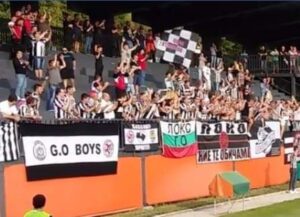
We already had the impressive mob for our standards, of 300 fellas. Not many cops were around as security had been taken care of by private companies. Lokomotiv (GO) also experienced financial difficulties after their relegation from the top flight in 1994/95, alternating the second division and the Amateur League for some ten years, which resulted in the loss of interest in football for the majority of Gorna Oryahovitsa citizens. Probably that was the reason why the ground was not sold out for that game. We stood there wondering why there weren’t any Botev fans. We had read in the papers (including photos and a lot of info) that their fans were looking for a fight with some Plovdiv gangsters that had some tight connections with their club owner. We thought they were boycotting the game. A few minutes into the first half, however, we heard some bomb explosions and the roar of hundreds from behind the southern gates of the ground. For fuck’s sake! Where the hell did they come from and why were they late? They stormed the gates spreading around beyond the area segregated for away fans and suddenly all hell seemed to break loose. They were more than 350 and like an avalanche, they went down the steps of the southern stand onto the running track. The police escort hurriedly pushed them back into the away fans’ pen. Most grounds had such types of fenced areas to prevent more serious aggro. They kept on throwing bombs and smoke canisters, gesturing and hurling abuse at us. The police were finding it difficult to cope with them and the Bultras invaded the pitch a few times during the game. They tried to get into a fight with the security guards but failed. The home fans’ entire attention was directed at the away end rather than at the football though the game was quite interesting. We hit back by passionately supporting our team throughout the match, challenging our rival fans, and throwing insults at them and their players. We also lit up a few smoke bombs and the atmosphere resembled a top-flight game rather than a second division fixture. We hoped something would happen come the end of the game. We hoped we could get into a fight with them as it was a matter of honour for us, and besides, it was going to be a top football hooligan scene for Bulgaria. We got even more irritated by the fact that Botev beat us 4-2. I can’t remember any details of goal scorers and the like as my attention was more often drawn to the opposite end where the Bultras wouldn’t stop making trouble for the Old Bill, who several times rammed through them using their shields and truncheons. A cop had got hit on the head with a stone and that escalated things. Their notorious hooligans did not fear the cops at all. On the contrary, they would fight them back with fists and boots. An angry mob of 350 brutal thugs against dozens of cops was a rather serious problem. Tensions kept on rising with every minute gone and what everyone had expected happened just seconds after the final whistle. Some 100 of them invaded the pitch trying to get at us but were challenged at the halfway line by several coppers and about 50 JRF. At first, we were outnumbered, but still, we engaged in a toe-to-toe fight throwing punches and kicks all around. There were fighting couples all around and a stunning brawl followed. One of them got knocked
down and 5 or 6 of our lads started kicking him all over. Others were exchanging flying kicks. The
Old Bill stepped in and tried to set us apart. A mate of ours, a Levski fan, was tussling with a
Bultras bloke on the floor and had sunk his teeth into his throat just like a Pitbull would. The coppers were trying to pull him away, but he just wouldn’t let go of his prey. I had never seen
anything like that before. I felt like watching the Hannibal film sequence…
Who have you come unstuck against?
Minyor Pernik, they have a decent firm. They are a mob of enraged Orcs (that’s how fans of other clubs mockingly call them). The southwestern part of Bulgaria was the region that, believe me, nobody wanted to travel to on an away day. In the next lines, we’ll attempt to explain why. There are three large towns in the region that we can surely call “the triangle of death”. Truly hostile places and a real challenge to all visiting football fans.
Name is 5 firms you rate and why?
Sofia West (Levski Sf), SS Front (CSKA), Izgrev Boys (Botev Plovdiv), Lauta Hools (Lokomotiv Plovdiv) and Minyor Pernik.
They are decent and notorious firms having proper game lads and always at the front.
Name 5 firms you don’t rate and why?
Cherno More (Varna), Dunav Ruse, Shumen, Lokomotiv Mezdra and Spartak Pleven. I don’t rate them because they have never been a factor at the casual scene. They are awful mobs….
What clobber do you wear down the match?
I am into the clothes side of things but not to the extent of many others. For me, it was all about the fighting and simple as that, rather than the clothes, but don’t get me wrong, it’s still nice to dress nice. I would say Adidas or Fred Perry trainers, a Fred Perry T-shirt, and a Stone Island jacket.
What was your music scene on your awayday?
I would say heavy metal, hard rock, and punk. They went hand in hand with the whole football scene in Bulgaria.
What’s your favourite all-time song?
I was heavily influenced by heavy metal music and all bands playing that, but my favourite all-time songs are Under Jolly Roger and Brotherhood of Running Wild and Run to the Hills of Iron Maiden.
What books have you written?
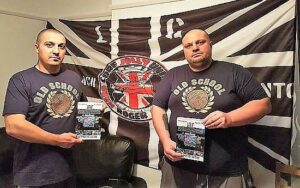
I am the author of three books in football-related-Hoolie-Ultra/Sports literature genre: JRF-Beyond the Hatred, Top Faces A Hooligan Legacy, and Retro Loko. The first two books were released in Bulgaria and in England too. My co-author is Tosh McIntosh. You can find them in amazon.co.uk
JRF Beyond the Hatred – this is the original story of the hooligan firm called Jolly Roger Firm (JRF), and how we were involved in it over the past two decades. It is a journey into a time when there was no football firm in Gorna Oryahovitsa (a small industrial town in Northern Bulgaria, short named G.O) yet and the founders of the JRF were innovators and among the first into the football clashes. We clashed against bigger firms and smaller ones, the number usually decided who won or lost, but sometimes it comes down to those people you’ve got behind and around you. We defended every inch of our ground and never allowed our home end to be taken. The roar of the lads around you, the sounds and blows from the fists and kicks in a row we’ve had, the adrenaline that bursts into your head, the thought of defending your town and club’s honour, the feeling of infinite freedom – trust us, this was the most exciting thing in the world. A feeling that money cannot buy! Apart from all that, there were those old-fashioned values of allegiance, friendship, and loyalty, which, unfortunately, no longer exist nowadays. This very loyalty and respect for one another formed us as a group and influenced many (even enemies) and that’s how we’ve created a close friendship with Bulgaria and England due to our mutual love for the game called football. One of the chapters in our book is dedicated to Chelsea Pat (Fat Pat) Dolan (RIP) who had been our mate since 2001. He was a real inspiration for us and told us: “Go on, do it! Why not?” Pat was a well-known and respected character, a true gentleman, and a fascinating storyteller.
Top Faces BG (Old School Terrace Legends) – A quite different look at the football fandom in his
germ. Written by football supporters for other fans, the book meets you in a particularly fascinating way with representatives of the most notorious firms in Bulgaria. With this great
project, you get a chance to read the stories of fans of several generations who, while opposing each other, are driven by the same feeling – love for their respective football club and
country. In the beginning, the book tracks the subcultures that have formed the fan cores in the past, such as punk rock, skinhead, and heavy metal, as well as fashion and social life at the time. These cores were mainly created by the working-class people with clearly noticeable clothing and style.
It was blues and jazz in the beginning, but rock and roll took his toll and become the real revolution
in music. Emerged a little later this style in music was the vent for all negative emotions, stressful situations, problems and was kind of meant to fight the Communist regime. The book provides a
meeting with some of the most prominent representatives of those cores. They tell stories that are
still a taboo topic in our society as a whole. All of them are long-standing personalities, different by
spirit and nature. They participated in the subcultural wave in our country (musical and fashion
movements), in rallies and demos against the hateful communist regime and after its end. Different by music style (hippies, metalheads, punks, skinheads), but all from the working class, they join
together as one and moved on the terraces. Told from inside are football-related fights and battles
in different cities. There are some stories about emblematic hardcore football fans who tell where the roots are and where it all comes from.
And lastly, tell us what you enjoyed about being a football casual?
What I enjoyed about being a football casual is representing Lokomotiv GO. I love the casual
scene and of course the camaraderie within your lads. You make life long family friends within
the scene.
Thanks for taking the time to talk to us at Awayday radio.
Proud Sponsors of The Terrace Casuals Interviews. (click pic for link)